
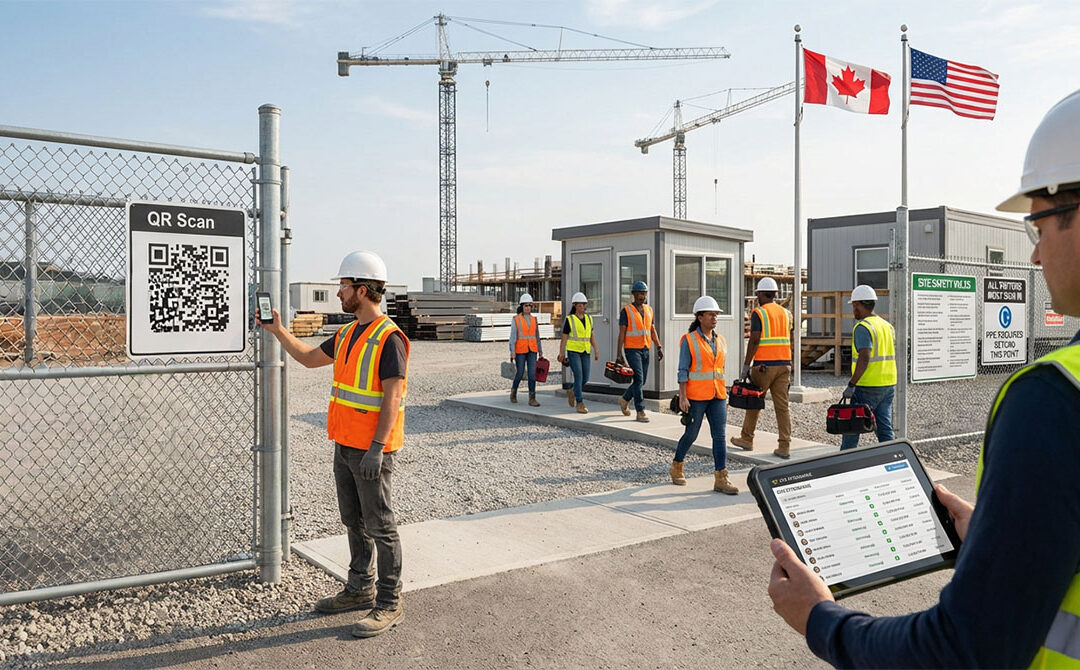
Running projects in Canada is not the same as “working in Canada.”
If you’re a general contractor operating across multiple provinces—or a U.S. contractor expanding north—you’re actually dealing with multiple regulatory environments:
- Different OH&S Acts and enforcement styles
- Different workers’ compensation incentives
- Different apprenticeship ratios
- Different safety inspection frequencies
- And in Quebec, different language rules for almost everything
This complexity is exactly where a simple, digital platform like Safe Site Check In (SSCI) provides leverage: one tool to standardize digital jobsite check-ins, inspections, and safety documentation across very different sites and jurisdictions.
Below, we’ll outline the key Canada vs. U.S. differences and show how SSCI helps you stay compliant without burying your team in admin.
Digital Jobsite Check-Ins in Canada vs. U.S.: Different Rulebooks, Same Goal
In the U.S., OSHA sets a federal baseline and emphasizes risk-based, “frequent and regular” inspections by a competent person.
In Canada, each province:
- Runs its own Occupational Health & Safety (OH&S) Act
- Has its own regulator and insurance system (e.g., WSIB/MOL in Ontario, WorkSafeBC in British Columbia, CNESST in Quebec)
- Enforces its own safety, inspection, and documentation rules
For contractors working across provinces—or crossing the border—this means:
- You can’t rely on a single “North American” safety playbook.
- You need site-specific workflows that still roll up into a single source of truth.
Where SSCI fits:
Safe Site Check In gives you configurable, site-level digital jobsite check-in and safety flows that still feed into one central dashboard. That lets you adapt to Ontario vs. B.C. vs. Quebec vs. U.S. while keeping your data and reporting consistent.
How Provincial OH&S Rules Affect Digital Jobsite Check-Ins
Every Canadian province has its own OH&S Act and enforcement style. That shows up in how safety responsibilities and documentation are managed on each construction jobsite.
Ontario: Safety Training and Immediate Consequences
Ontario emphasizes:
- Fall protection at 3 m (10 ft) and strict safety training (e.g., Working at Heights)
- The Internal Responsibility System (IRS), where everyone on site shares responsibility for safety
- Workers’ compensation premiums that can swing quickly based on your recent claims history
For general contractors, a bad year in Ontario can get very expensive very fast if incidents spike or documentation is incomplete.
British Columbia: Long-Term Safety Performance
British Columbia emphasizes:
- Similar fall protection heights (around 3 m / 10 ft)
- Proactive hazard identification and strong worker participation in safety
- Long-term performance when adjusting workers’ compensation premiums
In B.C., safety investment is about proving sustained performance over time, not just surviving one good inspection.
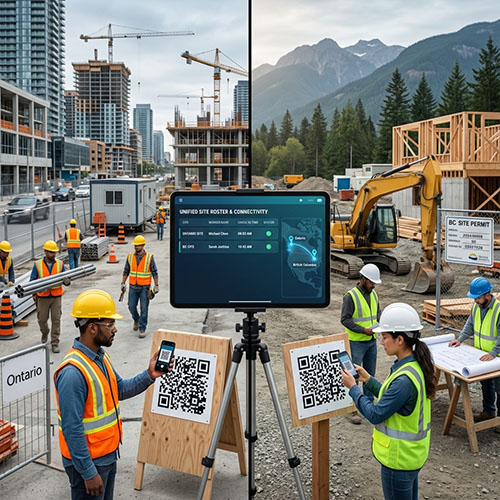
Why Digital Jobsite Check-In Records Matter
Across provinces, safety managers and project teams need clean, time‑stamped records of:
- Who was on site
- When they were there
- What orientations, safety forms, and inspections were completed
Any gap in documentation can show up later in claims, fines, or lost bids.
How Safe Site Check In helps:
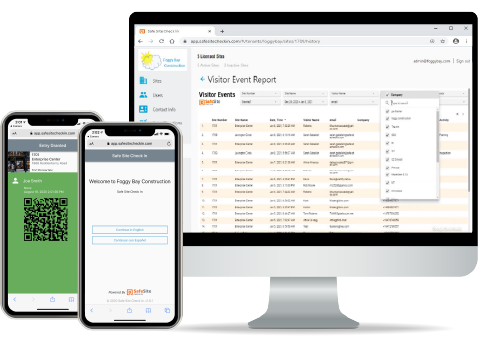
- Fast QR jobsite check‑in for workers and visitors — no app required.
- Role-aware digital check-ins: Different questions and safety forms for workers, subcontractors, visitors, and deliveries.
- Automatic daily logs and live rosters, so you always know who is on site.
- Exportable records (CSV/PDF) for audits, incident investigations, or insurance reviews.
Safe Site Check In keeps your jobsite check-in and safety records in one place, even when your projects span provinces with very different OH&S rules.
Construction Apprenticeship Ratios and Workforce Management in Canada
Apprenticeship rules are a hidden constraint on workforce management and scheduling for contractors.
Different Apprenticeship Ratios by Province
- Manitoba has moved to a 1:1 journeyperson-to-apprentice ratio.
- Many other provinces use 2:1 or higher ratios.
You can’t take a crew mix that works in one province and assume it’s legal in another. A crew that’s compliant in Alberta might not be compliant in Manitoba.
Why Digital Workforce Data Matters
For schedulers and site supervisors, this means:
- You must know exactly who is a journeyperson, who is an apprentice, and who is a visitor or subcontractor on each jobsite.
- You need a real-time roster that reflects those roles accurately to stay within local apprenticeship ratio rules.
How Safe Site Check In helps:
- Capture roles and certifications at digital check-in (journeyperson, apprentice, visitor, subcontractor, etc.).
- Use the live roster to see exactly who is on site and in what capacity.
- Export a site roster report if you need to confirm compliance with local apprenticeship ratios for a regulator or owner.
Instead of chasing spreadsheets, you get practical, real-time visibility into who is actually on the ground, jobsite by jobsite.
Quebec Construction Language Requirements and Bilingual Check-Ins
Quebec adds a second layer of complexity via the Charter of the French Language (Bill 101 / Bill 96).
Key Quebec Construction Language Rules
For contractors operating in Quebec:
- French is the normal language of work.
- Companies with 25+ employees in Quebec must register with the OQLF and follow a Francization program.
- Safety training documents, job descriptions, and communications with the government must be available in French.
- Public contracts and much site signage must be primarily in French.
A check-in or safety system that only works in English will quickly become a liability in Quebec.
Bilingual Digital Jobsite Check-Ins in Quebec
To comply in Quebec, contractors need bilingual processes:
- Workers must be able to read and acknowledge jobsite rules and safety questions in French.
- Check-in flows, orientations, and safety forms should be bilingual (French and English) where appropriate.
- Site signage and visual prompts need to reflect Quebec’s requirement for the predominance of French.
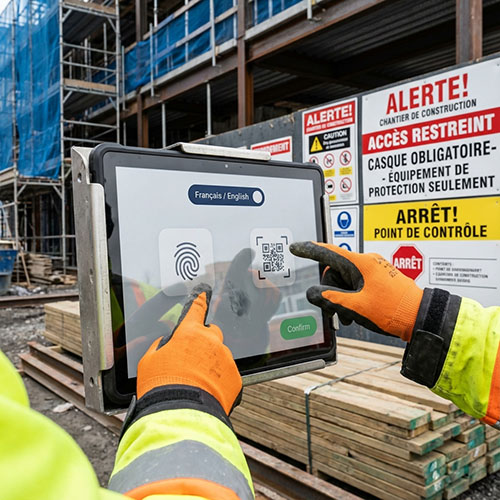
How Safe Site Check In helps:
- Multi-language capable: Configure digital jobsite check-in flows, orientations, and forms for French and English, so workers in Quebec can read and acknowledge site rules in French.
- Standardize templates centrally, then localize wording for Quebec without rebuilding forms from scratch.
- Ensure check-in confirmations, site rules, and safety questions are presented in the right language for each jobsite.
Safe Site Check In makes it practical—not painful—to respect Quebec’s construction language requirements while keeping your digital jobsite check-in workflows consistent across the rest of Canada and the U.S.
Construction Site Safety Inspection Frequency: Canada vs. U.S. OSHA
One of the biggest practical differences between Canadian and U.S. construction safety compliance is how often sites must be inspected—and how that frequency is defined legally.
Safety Inspection Frequency in Canadian Construction
In Canada, inspection frequency is often explicitly legislated:
- Ontario (construction) requires weekly documented inspections by supervisors.
- Many provinces require a Joint Health and Safety Committee (JHSC) or worker representative to inspect the workplace monthly, ensuring the entire site is inspected over a defined period.
- Supervisors are expected to do continuous/daily inspections, often logged in a simple form or notebook.
If you don’t have time‑stamped, auditable records for weekly and monthly inspections, you’re at risk in an audit or after an incident.
OSHA Safety Inspection Requirements in the U.S.
In the U.S., OSHA requires “frequent and regular” inspections by a competent person, but does not define a standard weekly or monthly schedule for general site inspections.
- Inspection frequency is driven by hazard severity and project phase.
- There are specific prescriptive rules for certain equipment and tasks (e.g., cranes, scaffolding), but not a universal calendar-based rule for every site.
For cross-border contractors, that means:
- In the U.S., your documentation must show that inspections were sufficient for the risk.
- In Canada, you also need to prove you met weekly and monthly minimums and kept proof.
How Safe Site Check In helps:
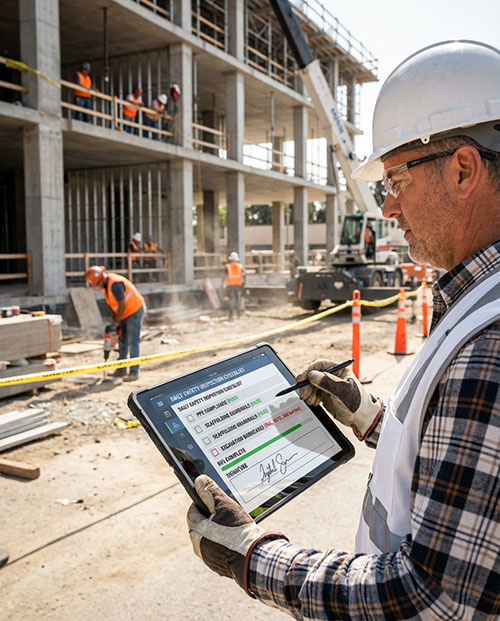
Digital Safety Inspection Checklists and Records With SSCI
- Configure inspection templates and schedules per jobsite:
- Weekly supervisor inspections (Ontario and other provinces)
- Monthly JHSC inspections
- Task- or equipment-specific safety inspection checklists
- Log inspections directly from a phone or tablet—no extra hardware required.
- Keep a searchable history of completed inspections, with date, time, jobsite, and responsible person.
- Export digital safety inspection records when regulators, insurers, or owners ask for proof.
Instead of chasing paper forms, you search, filter, and export digital inspection data from one place.
Why GCs Should Choose Safe Site Check In for Multi-Province and Cross-Border Projects
Safe Site Check In’s comprehensive features benefit construction and industrial environments where compliance, safety, and visibility matter—but where teams don’t have time for complex software rollouts.
Key Benefits of Safe Site Check In for Construction Contractors
- Minutes to launch, not weeks
- Print a QR code, post it at the gate or trailer, and you’re live.
- No specialized hardware required; workers use their own phones.
- Easy digital jobsite check-in for workers and visitors
- Scan with a phone; no app installation.
- Simple, guided flows that can capture:
- Site rules acknowledgement
- JHA/JSA or pre-task plan confirmation
- Visitor purpose, company, and contact details
- Real-time jobsite visibility and construction workforce management
- Live roster of who is on site, across all your active projects.
- Central dashboard for multi-site teams, including cross-province and cross-border operations.
- Compliance-ready safety and inspection records
- Digital logs of check-ins, safety acknowledgements, and inspections.
- Exportable for audits, incident reviews, client reporting, and insurance.
- Built for multi-site, multi-region construction compliance
- Site-specific rules and forms, with standardized templates.
- Works in Canada and the U.S., including bilingual check-ins for Quebec.
- Fits into your existing construction workflows
- SSCI complements your existing project management, HR, and EHS programs.
- Simple data exports for reporting, analysis, and long-term record-keeping.
FAQ: Digital Jobsite Check-Ins for Canada and U.S. Contractors
Why are digital jobsite check-ins important for contractors working in multiple Canadian provinces?
Digital jobsite check-ins centralize your roster, safety acknowledgements, and inspection records. Because each Canadian province has different OH&S, inspection, and workforce rules, a digital system gives you a single, accurate source of truth you can use to prove compliance in every jurisdiction without maintaining separate paper processes on each jobsite.
How does Safe Site Check In support Quebec construction language requirements?
Safe Site Check In supports bilingual French and English check-in flows. Workers at Quebec jobsites can read and acknowledge site rules, safety questions, and forms in French, while you keep standardized data across all your sites in Canada and the U.S. This helps you respect the Charter of the French Language without creating a separate tool just for Quebec.
What’s the benefit of digital safety inspection records versus paper checklists?
Digital safety inspection records are time‑stamped, searchable, and easy to export for audits or insurance reviews. In provinces like Ontario that require weekly and monthly inspections, it’s much simpler to prove that inspections were completed on schedule when every record is stored in one digital system instead of scattered across clipboards and notebooks.
Do workers need to install an app to use Safe Site Check In?
No. Workers and visitors simply scan a QR code at the jobsite entrance with their smartphone. Safe Site Check In opens in their browser, so there’s no app installation or account setup required. This makes deployment faster and keeps adoption high, even with rotating subcontractors and visitors.
Can Safe Site Check In be used for both Canadian and U.S. jobsites?
Yes. Safe Site Check In is designed for multi-site, multi-region construction teams. You can configure site-specific check-in flows and inspections for different provinces and states while still managing everything from a single, centralized dashboard.
See Digital Jobsite Check-Ins in Action
If you’re:
- A Canadian GC juggling projects across multiple provinces, or
- A U.S. contractor bidding or building in Canada for the first time,
you don’t need another complex system—you need a simple, reliable and affordable way to know who is on site, what they acknowledged, and which safety inspections were completed.
Safe Site Check In gives you:
- One consistent digital jobsite check-in platform
- Site-level flexibility for each province or state
- Clean, auditable records when you need them
Next step:
See how Safe Site Check In works on a job like yours.
Book a short walkthrough and we’ll show you how to:
- Stand up a pilot jobsite in minutes
- Configure check-ins and inspections for your Canadian provinces and U.S. states
- Support both English and French where required
- Give your supers and safety team better visibility with less manual work
You’ll leave the demo knowing exactly how SSCI can help you run safer, more compliant construction sites across Canada and the U.S.—without adding admin overhead.

Our Safe Site Check In web app can Make Jobsite Management Easy™. SSCI automates check-in with safety screening, badging, onboarding and daily log creation. Our solution has been used on thousands of sites for millions of screenings in construction and other industrial worksites by thousands of employees and visitors every day. Used worldwide, built and supported in the USA.