
The Federal Compliance Mandate: Operational Challenges for Prime Contractors
Executing federally funded or assisted public construction projects offers lucrative backlog opportunities but carries rigid regulatory oversight. Reliance on manual paper logs, spreadsheet tracking, or generic sign-in apps creates critical reporting gaps. For general contractors, field data errors can lead to immediate project friction, and if not addressed, even frozen agency funding, financial penalties, or three-year debarment from public work.
Automated Field Data Capture
By automating the site entry process, prime contractors establish a continuous, real-time data pipeline to monitor multi-tier workforce attendance, digital daily logs, and shifting site conditions. Our digital field system efficiently captures the precise worker identities, specialized trade classifications, and daily split-times required by accounting teams or third-party payroll firms.
Watch our short video to learn more about how Safe Site Check In eliminates administrative reporting delays and reinforces compliance enforcement across the federal jobsite.
Critical Risk Factors in Federal Infrastructure Delivery
General contractors executing public works must manage intensive regulatory oversight and complex field recording requirements. Gaps in manual jobsite data tracking expose firms to severe financial liabilities, audit penalties, and immediate contract vulnerability.
Expand the sections below to analyze the primary operational risk factors on federal jobsites and see how automated data capture addresses each compliance mandate:
Trade Classifications & Split-Shifts
Prevailing wage rates under the Davis-Bacon Act are tied strictly to localized county schedules and specific worker crafts. When a laborer or mechanic transitions between multiple distinct roles within a single shift, supervisors must document the exact time split to verify accurate compensation scales.
Subcontractor Strict Liability
Prime contractors explicitly own the compliance chain and face strict liability for the labor recordkeeping failures of down-tier subcontractors. Real-time visibility into subcontractor hours is critical to protecting the prime from downstream wage violation claims.
Apprentice Ratio Enforcement
Paying reduced apprentice wage percentages is illegal unless the worker is actively registered in a Department of Labor (DOL) recognized training program. General contractors must maintain jobsite records proving that contractually mandated daily journeyman-to-apprentice ratios were systematically met in order to claim federal tax credits.
Three-Year Audit Mandates
Federal infrastructure guidelines dictate that all core workforce compliance data—including signed time records, daily logs, and proof of payments into “bona fide” fringe benefit plans—be preserved in an unalterable digital archive for at least three years post-completion.
Cybersecurity & Data Protection
As federal security enforcement updates expand through frameworks like CMMC 2.0, sensitive project tracking data and personal identifier records are scrutinized as Controlled Unclassified Information (CUI). Jobsites must employ secure software structures to safeguard supply chain data integrity.
The Anatomy of Modern Federal Construction

Safe Site Check In: System Capabilities & Compliance Matrix
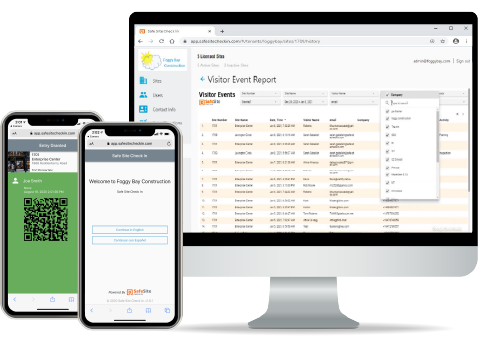
Safe Site Check In (SSCI) converts standard field sign-ins into an automated compliance data pipeline. Utilizing secure QR-code check-ins across user-provided smartphones, tablets, or rugged kiosks, the software gathers accurate workforce data directly at the site perimeter.
| Federal Regulatory Trigger | Safe Site Check In Feature | Operational Infrastructure Outcome |
|---|---|---|
| Weekly Certified Payroll Reports Mandatory submission of Form WH-347 on covered contracts exceeding $2,000. | Workforce Profile Ingestion: Captures legal name, address, craft classification, and the last four digits of SSNs upon site entry. | Pristine Payroll Foundations: Provides corporate teams or payroll vendors with verified data fields to populate weekly filings on time. |
| Davis-Bacon Wage Determinations Field enforcement of mandatory base hourly pay scales and fringe packages. | Trade-Specific Craft Allocation: Tracks real-time labor distribution and supervisor-approved daily split-time shifts. | Eliminate Classification Errors: Establishes a granular digital audit trail to confirm precise craft time allocation across variable tasks. |
| Apprentice Utilization Mandates Validation of lower-tier training status and sub-journeyman rate compliance. | Credential Storage Expansion: Archives digital proof of active apprenticeship enrollment and union standing during onboarding. | Verify Site Training Ratios: Generates historical jobsite logs to prove daily ratio parameters were maintained by all subcontractors. |
| Multi-Tier Subcontractor Risk Prime contractor exposure to down-tier record gaps and labor anomalies. | Subcontractor Portal & Delegation: Allows general contractors to view down-tier hours in real-time or delegate profile management to foremen. | Standardized Site Recordkeeping: Protects the prime contractor's liability by enforcing absolute transparency across all subcontractor tiers. |
| Consecutive Reporting Rules Enforcing sequential tracking integrity during temporary site pauses. | Continuous Daily Attendance Logs: Maintains time and duration metrics across shifting weather or project phases. | Validate Non-Performance Weeks: Factual ledger history simplifies compiling mandatory sequence "Statements of Non-Performance". |
| Audit Defense & Records Retention Fulfilling subsequent agency record requests without administrative delays. | Permanent Encrypted Archiving: Stores signed time records, daily logs, and site responses in an access-controlled cloud database. | Instant Digital Retrieval: Replaces paper filing boxes with a searchable, secure central archive accessible by HQ and field teams. |
Enterprise Integration & Security Standards
Safe Site Check In is engineered to remove manual entry bottlenecks and interface seamlessly with existing enterprise construction management ecosystems.
Unified Project “Source of Truth”
Procore Integration: Synchronizes real-time field count metrics, active manpower summaries, and visitor check-in logs directly into Procore daily construction logs.
Autodesk Construction Cloud (ACC): Connects field presence data straight to your central asset models via an API setup completed in under 30 minutes.
Find us on the Procore Marketplace >>
Find us on the Autodesk Marketplace >>


Technical Security Architecture
Role-Based Access Controls: Restricts workforce profile records, personal tracking data, and background certification histories to authorized supervisors and safety executives.
Google Technology Infrastructure: Data authentication, cloud encryption, and platform security are managed via secure infrastructure layers, keeping data protected between the subcontractor and the general contractor.
Zero-IT Field Deployment: Bypasses native software downloads, device procurement, and technology training costs. Field superintendents deploy secure access tracking via weather-resistant QR posters scanned on any standard mobile browser.
Operational Outcomes by Construction Management Role

Project Managers & Executives
Eliminates manual data entry duplication across multiple remote jobsites to reduce total administrative overhead costs.
Leverages accurate actual-hours-on-site analytics to evaluate project progress against initial bids and safeguard margins.

Site Superintendents & Field Supers
Replaces tedious clipboards and paper logs with a rapid, contactless, bilingual field onboarding interface (English and Spanish standard).
Drives instantaneous site-wide emergency broadcasts and notifications to satisfy mandatory Emergency Action Plans (EAP).

Compliance & Safety Officers
Automatically screens for current worker safety certifications, tool talk acknowledgments, and site compliance credentials upon check-in.
Collects signed daily records and immediate incident reporting data to secure protection against False Claims Act exposure.
Frequently Asked Questions
Does Safe Site Check In directly run certified payroll computations or cut employee checks?
No. Safe Site Check In serves as an automated field data collection system. It captures the precise check-in timestamps, specific trade classifications, and daily split-shift tracking required by your corporate payroll department, or third-party certified payroll software, to generate weekly Form WH-347 reports accurately.
How does the system handle personnel who transition between different labor categories or crafts mid-shift?
The software supports customizable check-in configurations and trade-specific logs. If a worker shifts roles, the system allows the field team to record the exact split-time distribution, generating the clear audit history needed to comply with complex wage determination schedules.
Are independent administrative personnel or project supervisors required to be logged for Davis-Bacon?
Executive, clerical, administrative, and supervisory personnel who do not perform physical or manual labor on-site are generally exempt under prevailing wage rules. However, job titles alone do not govern coverage; if a superintendent or estimator performs manual work on-site, those specific hours must be documented and paid at the prevailing wage rate.
How does Safe Site Check In handle weeks where weather or project pauses result in zero on-site labor hours?
By maintaining continuous daily attendance tracking logs, the system provides project management teams with the precise historical evidence needed to verify zero-work weeks, validating sequential “Statements of Non-Performance” for the contracting agency.
How is sensitive workforce identity data protected from external visibility?
All personal data and site documentation are encrypted and securely stored cloud-side, rather than on local field devices. Profile details are accessible strictly to authorized prime contractor administrators via secure permissions and are never sold or used for commercial advertising.